 isospins
AI Readiness Assessments
Review business goals, data, systems, skills, and operating constraints. Identify what is ready for a prototype and which dependencies need attention first.
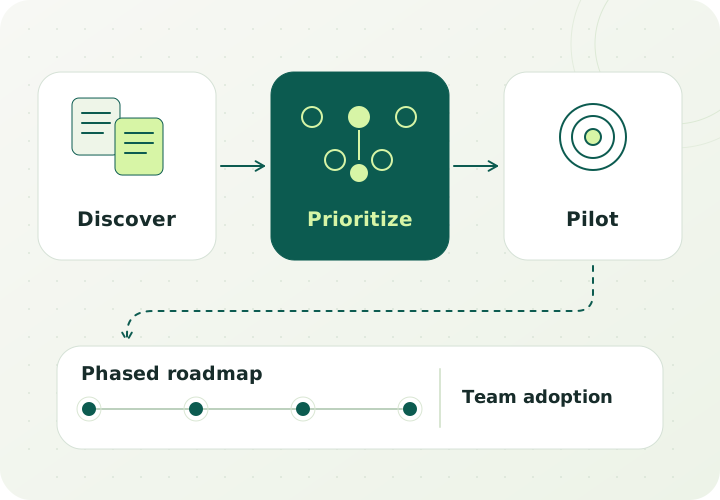
Decide where AI belongs in your organization and what to do first. Connect readiness, use-case prioritization, technology choices, change management, and training in a practical adoption roadmap, including agentic AI opportunities where actions and responsibilities can be clearly defined.
Scope the right combination of capabilities for your organization, data, and intended outcome.
Review business goals, data, systems, skills, and operating constraints. Identify what is ready for a prototype and which dependencies need attention first.
Translate priorities into phased work with owners, dependencies, and investment assumptions. Set decision points so evidence from early projects can reshape later commitments.
Compare opportunities by business value, feasibility, information access, and decision consequences. Turn broad ideas into specific workflows with measurable acceptance criteria.
Prepare teams for new tools and responsibilities through role-specific exercises. Define review, escalation, feedback, and ownership within the workflow people will actually use.
Connect business sponsors, domain specialists, and engineering teams around a shared problem statement. Resolve integration and operating questions before committing to a solution.
Create a repeatable process for reviewing new capabilities and retiring weak experiments. Keep the roadmap responsive to evidence, changing needs, and the cost of operation.
Research reviewed October 27, 2026. Recent standards, research, and platform developments connected to practical project decisions.
Microsoft's October 2026 adoption guidance distinguishes employee assistance, workflow automation, and custom AI platforms. It connects the choice to business value, customization needs, operational ownership, shared governance, and workforce training.
Prioritize use cases with a named business owner, an evaluation baseline, investment assumptions, and a plan for adoption. Compare an existing tool, a configured service, and a custom build before committing to implementation.
NIST's 2026 AI Agent Standards Initiative focuses on interoperability, open protocols, security, and agent identity research. This is an active standards effort, with voluntary guidance and technical work still developing.
Document who owns each agent, which systems and actions it may access, and how changes will be reviewed. Keep protocol and governance assumptions visible in the roadmap so the architecture can adapt.
Source dates indicate publication or last update. Drafts, regional examples, and product announcements are identified in context. The project implications are Isospins’ recommendations for scoping an engagement.
An illustrative engagement to shape around your organization, systems, and priorities.
Discuss a first projectBring a small set of business problems to a working session. Compare value and readiness, select one feasible experiment, and agree what evidence would justify the next phase.
Decide where AI belongs in your organization and what to do first. Connect readiness, use-case prioritization, technology choices, change management, and training in a practical adoption roadmap, including agentic AI opportunities where actions and responsibilities can be clearly defined.
Define the use case, relevant industry context, integrations, evaluation criteria, and operating responsibilities before implementation. Our consulting work connects strategy, engineering, adoption, and handover.
Find your industryBring these questions to the first conversation. We can work through the unknowns together.
Start a conversationWhich business outcome and baseline will determine whether an AI investment is useful?
What people, data, governance, and integration gaps must be addressed before the first release?
Who will own adoption, professional review where needed, recurring costs, and decisions about expanding or stopping the work?
Start a conversation about your application, AI opportunity, or cloud environment.