 isospins
Generative Content Creation
Draft and adapt content using approved material, tone, and review rules. Evaluate accuracy, source use, and editorial quality before publishing or sending output.
Design useful generative AI experiences for content, knowledge, product design, and document workflows. Scope large language models (LLMs), synthetic data, fine-tuning, and agentic AI around approved information, bounded actions, evaluation, and human review.
Scope the right combination of capabilities for your organization, data, and intended outcome.
Draft and adapt content using approved material, tone, and review rules. Evaluate accuracy, source use, and editorial quality before publishing or sending output.
Explore generated examples for development and evaluation when appropriate. Test representativeness and disclosure risk; synthetic data still needs a documented quality and privacy assessment.
Prototype product concepts, requirements, and design variations with a team. Keep decisions connected to user evidence, feasibility, and review by the people responsible for delivery.
Build language-model experiences around retrieval, structured output, or bounded tools. Compare model options against your task, information access, response time, and operating cost.
Explore visual concepts and media workflows with brand guidance and editorial review. Clarify usage rights, provenance expectations, and approval responsibilities within the engagement.
Assess prompting, retrieval, and fine-tuning against the same evaluation set. Choose customization and hosting only when the observed behavior and operational requirements justify them.
Research reviewed October 27, 2026. Recent standards, research, and platform developments connected to practical project decisions.
Current grounding tools connect generated responses to documents, search indexes, or external search APIs. Google Cloud documents several retrieval options and source references, making information access and retrieval design part of the application architecture.
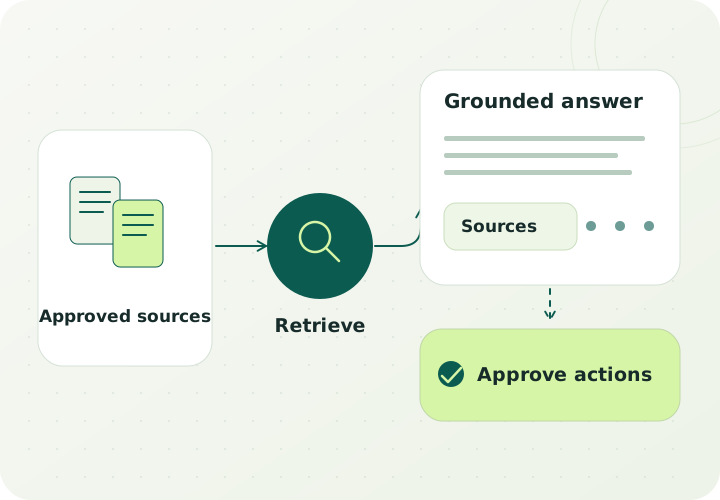
Define the approved knowledge sources, access rules, update process, and answer checks. Test whether retrieved material supports the response; a citation alone is not a quality guarantee.
Google's July 2026 evaluation release covers task completion, tool use, grounding, and execution traces during development and on production traffic. Agentic applications need evidence about the workflow they perform, as well as the text they produce.
Create representative tasks, expected tool behavior, failure cases, and human-review checkpoints. Track quality alongside latency and operating cost before expanding an agent's responsibilities.
Source dates indicate publication or last update. Drafts, regional examples, and product announcements are identified in context. The project implications are Isospins’ recommendations for scoping an engagement.
An illustrative engagement to shape around your organization, systems, and priorities.
Discuss a first projectConnect a small set of approved documents to a source-linked assistant. Start with read-only answers, a realistic question set, and a clear route to a person when evidence is missing.
Design useful generative AI experiences for content, knowledge, product design, and document workflows. Scope large language models (LLMs), synthetic data, fine-tuning, and agentic AI around approved information, bounded actions, evaluation, and human review.
Define the use case, relevant industry context, integrations, evaluation criteria, and operating responsibilities before implementation. Our consulting work connects strategy, engineering, adoption, and handover.
Find your industryBring these questions to the first conversation. We can work through the unknowns together.
Start a conversationWhich task should the system complete, and which actions require a person's approval?
What approved documents, examples, or synthetic data can support retrieval, evaluation, or a fine-tuning experiment?
What evidence would justify moving from a prototype to a production workflow?
Start a conversation about your application, AI opportunity, or cloud environment.