Small & midsize businesses

AI consulting for
growing businesses.

Connect AI, business data, and cloud systems to the work your team does every day. Isospins helps you choose a useful first project, define its scope, and decide what is worth building.

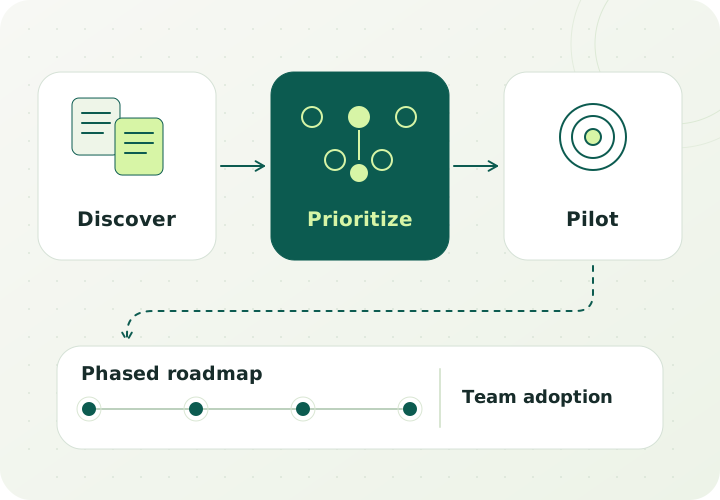
Discovery, prioritization, and a pilot inform a phased roadmap and team adoption.
AI strategy / a path from opportunity to adoptionConcept illustration
Built around the work

Make the work simpler. Give your business room to grow.

You may already have capable software and still spend too much effort moving information between it. Staff search folders for answers, rebuild the same spreadsheet, or work around an application that has become difficult to maintain. The starting point is the recurring task and the people responsible for it.

Our consulting services connect business discovery with AI strategy, generative AI, machine learning, data engineering, application integration, and cloud engineering. We can shape a focused engagement around one workflow before considering a wider rollout. The approach applies across industries and can include healthcare applications where appropriate.

Important knowledge is difficult to find

Answers live in policies, product information, shared files, and the experience of a few busy people. A document workflow or knowledge assistant can be scoped around approved sources and a visible review step.

For example: A service team finds the relevant policy and prepares a response for a staff member to check.

Reporting depends on repeated manual work

Teams export records from different systems, reconcile definitions, and rebuild reports. Data integration can bring a selected set of sources into a documented reporting workflow with quality checks and named owners.

For example: An operations manager reviews orders, stock, and outstanding work using the same agreed definitions.

Cloud costs and application changes need a clearer plan

A growing bill, a fragile deployment, or an aging application can make the next decision difficult. A cloud review can connect resources and recurring costs to the workloads they support, then prioritize changes.

For example: A business owner sees which application a resource supports, who owns it, and what to investigate before making a change.

Who this fits

A practical fit for teams with a defined problem

You do not need a completed technical specification. A useful first conversation needs a business owner, a workflow to examine, and an honest view of the systems and information involved.

  • Owners and operations leaders deciding where AI or automation would be useful.
  • Teams whose knowledge, reporting, or applications have become harder to manage as the business grows.
  • Businesses using several systems that need a clearer way to share selected information.
  • Organizations with an internal technical team or an existing provider that needs a defined implementation or review partner.
A scoped first engagement

Start with one workflow and an agreed decision

A scoped discovery engagement can establish what the problem is, whether the necessary information is available, and what evidence would justify a prototype or implementation. The proposal should make the deliverables and responsibilities clear before work begins.

  1. Map the current task

    Follow the inputs, decisions, handoffs, and exceptions. Identify the business owner and the people who will review the result.

  2. Compare practical approaches

    Assess a change to existing software, conventional automation, data integration, or AI against the task and the information available.

  3. Define a useful first scope

    Choose a bounded workflow, the intended users, evaluation examples, and any actions that require approval.

  4. Decide the next investment

    Review feasibility, dependencies, operating effort, and the proposed evidence. Agree whether to prototype, implement, improve the foundations, or stop.

What to bring

  • A description of the task, its users, and the point where work slows down or loses clarity.
  • The systems involved and the people who can explain their current use.
  • Representative examples and a way to assess the current process.
  • Any access, data-handling, operational, or contractual requirements that affect the scope.

What the scope can include

  • A workflow map and a concise business problem statement.
  • A systems, information-access, and readiness assessment.
  • A recommendation comparing the practical options and their tradeoffs.
  • A defined first-project scope with evaluation criteria and responsibilities.
  • An implementation or prototype proposal with dependencies and handover requirements.

The decision it supports: The outcome is a decision your team can understand: what to do first, why it fits, what must be in place, and how the work will be assessed.

How to judge the work

Agree the baseline.
Evaluate the whole workflow.

Define these measures with your team after reviewing the starting point. Use the findings to decide whether to expand the scope.

Effort on the task

Establish how staff currently complete the task, including searching, re-entering information, reviewing output, and resolving exceptions. Compare the proposed workflow against that baseline.

Quality of the result

Use representative examples to assess completeness, correctness, source visibility, and the work a person still needs to do. Set acceptance criteria before implementation.

Ability to operate it

Review recurring service costs, ownership, access administration, monitoring, and the clarity of the handover. Include staff feedback on whether the new workflow is usable.

Systems and ownership

Start with the access
you can account for.

Begin with the systems your business already uses. Examples to assess during discovery include:

  • Business spreadsheets, databases, shared folders, and approved document repositories.
  • Customer, accounting, commerce, inventory, and support systems with suitable export or API access.
  • Existing applications and cloud environments on AWS, Microsoft Azure, or Google Cloud.

Define the boundaries

We confirm the available interfaces, permissions, subscriptions, and data quality when defining the integration scope. Begin with the systems your team can access and the people who can explain how they are used.

Before we begin

Questions to help
you choose the next step.

How should a small business choose its first AI project?

Choose a recurring task that someone owns and can explain with real examples. Check that the necessary information is available, define what a useful result looks like, and include the review effort. An AI readiness or discovery engagement can turn those answers into a proposed first scope.

Do we need an internal AI or data team?

A technical department is not a prerequisite for discovery. You will need a business owner and access to people who understand the workflow and systems. The engagement should also agree who will administer, support, and approve changes after handover.

Can you work with our current software or IT provider?

The review can start with the tools and provider relationships you already have. Their interfaces, access permissions, and responsibilities help determine whether to configure existing software, add an integration, or build a separate capability. Any implementation scope should make those responsibilities explicit.

What if ordinary automation is enough?

Then it belongs in the comparison. A rule-based workflow, a better report, or a clearer application interface may address the problem without a model. We assess the approach against the task and the evidence it needs.

How are scope and cost determined?

They depend on the workflow, access, integrations, data readiness, and operating requirements. A proposal should define the deliverables, assumptions, responsibilities, commercial terms, and acceptance criteria before implementation. Discovery can help resolve the questions needed to prepare that proposal.

Do you only work on healthcare applications?

Isospins provides AI, data, cloud, and application consulting across industries. Our industry pages cover healthcare and life sciences; banking and insurance; legal and professional services; retail and e-commerce; manufacturing and supply chain; and government, education, and energy. Healthcare application development is one part of that broader practice.

Your next step

Bring the task that keeps coming back.

Tell us what your team is trying to improve, which systems are involved, and what would make the result useful. We can discuss a practical starting scope.

Discuss your first project

Prefer to organize the idea first?

Use the free project planner to create a short brief about your workflow, information, ownership, and evaluation.

Open the project planner
Let's build something useful

Big idea. Complex challenge.
Let's find your next step.

Start a conversation about your application, AI opportunity, or cloud environment.

Discuss your project