 isospins
Custom ML Model Development
Develop a model around your data and business question. Compare a simple baseline with more complex approaches, and document the tradeoffs before choosing a deployment path.
Turn a defined business question into a testable machine learning solution. Explore predictive analytics, natural language processing (NLP), and computer vision, with evaluation, model training, and cloud integration planned around the intended workflow.
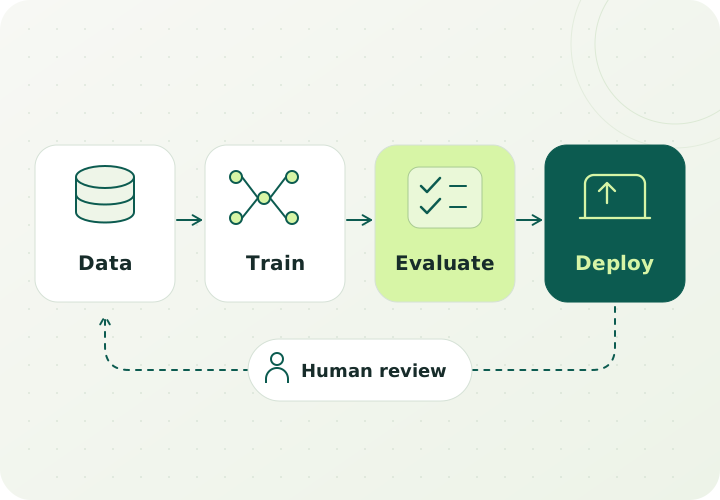
Scope the right combination of capabilities for your organization, data, and intended outcome.
Develop a model around your data and business question. Compare a simple baseline with more complex approaches, and document the tradeoffs before choosing a deployment path.
Use historical information to explore demand, workload, or risk forecasts. Evaluate performance on held-out periods and define how teams should respond to uncertainty.
Classify, extract, and organize language from documents, messages, and support requests. Define the vocabulary, language coverage, and exception handling for your workflow.
Explore image classification, detection, or inspection against a representative sample. Review lighting, labeling, error costs, and the role of a human inspector.
Improve training data, features, and model settings against agreed evaluation criteria. Track versions so a change in performance can be investigated and reproduced.
Connect model predictions to applications and data platforms. Plan inference, access, monitoring, rollback, and operating ownership alongside the model itself.
Research reviewed October 27, 2026. Recent standards, research, and platform developments connected to practical project decisions.
A 2026 AWS reference implementation connects dataset versions, training experiments, and a model registry. This makes the path from a deployed model back to its training data and evaluation artifacts inspectable.
Include dataset and code versioning, evaluation records, and model-promotion decisions in the engagement scope so your team can investigate a result or reproduce a release.
Current Google Cloud guidance describes baseline comparisons and drift alerts for tabular prediction models. Monitoring extends the initial evaluation by showing when production inputs move away from the conditions a model was assessed against.
Agree on permitted data capture, alert thresholds, an operational owner, and a review process for retraining. Verify the monitoring feature's support level before selecting it for production.
Source dates indicate publication or last update. Drafts, regional examples, and product announcements are identified in context. The project implications are Isospins’ recommendations for scoping an engagement.
An illustrative engagement to shape around your organization, systems, and priorities.
Discuss a first projectChoose a recurring decision such as staffing or stock planning. Build a historical baseline, compare an ML approach, and put the results in a reviewable dashboard before considering automation.
Turn a defined business question into a testable machine learning solution. Explore predictive analytics, natural language processing (NLP), and computer vision, with evaluation, model training, and cloud integration planned around the intended workflow.
Define the use case, relevant industry context, integrations, evaluation criteria, and operating responsibilities before implementation. Our consulting work connects strategy, engineering, adoption, and handover.
Find your industryBring these questions to the first conversation. We can work through the unknowns together.
Start a conversationWhat prediction, classification, NLP, or computer vision task would improve a specific business workflow?
Which representative data and evaluation examples can we use, and who can authorize access?
Who will review model quality, respond to drift, and approve a new model release after launch?
Start a conversation about your application, AI opportunity, or cloud environment.