 isospins
A useful project
starts with a clearer brief.
Explore a focused first step for your small or midsize organization. Five choices turn a broad idea into a project outline you can discuss with your team.
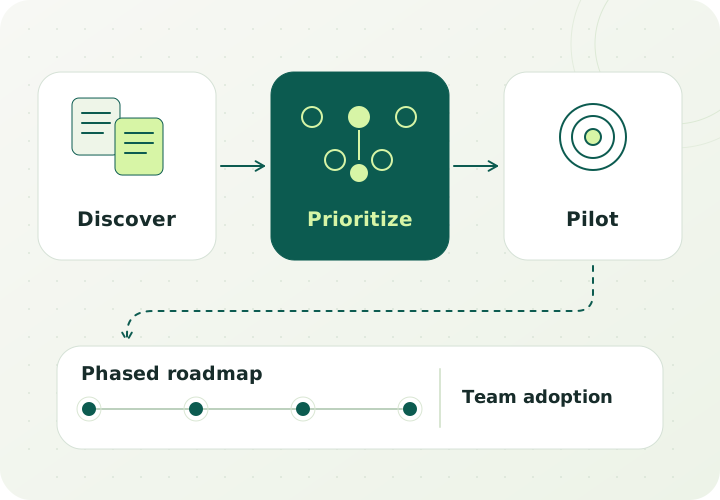
Five choices.
A useful starting point.
Choose a workflow, check the foundations, and leave with a first project your team can discuss.
Isospins framework
Prepare the foundations.
Make the test useful.
Keep the scope clear.
The output to aim for.
Use the brief to discuss the scope, source information, and next decision with your team.
Before the tool,
define the work.
A useful first project has a narrow task, inspectable information, and a person responsible for deciding what happens next.
Read the first-project guide- 01
Name one recurring task.
Describe who does it, where the friction appears, and what a useful result looks like.
- 02
Establish the current baseline.
Collect representative examples and note the current review effort, error patterns, and handoffs.
- 03
Confirm information and permission.
Identify approved sources, access rules, freshness requirements, and information that must stay out of scope.
- 04
Choose the owner and review step.
Assign the person who accepts the scope, checks the output, and handles exceptions before any action.
- 05
Compare AI with a simpler approach.
A clearer process, search interface, data pipeline, or conventional automation may be the right first investment.
- 06
Agree on evidence for the next decision.
Test accuracy, source support, permissions, failure behavior, and usefulness. Decide whether to proceed, revise, or stop.
Shape the first step.
This predefined Isospins planning framework matches your choices to project outlines. Use the discussion brief to confirm scope, information, ownership, and evaluation during discovery.
Big idea. Complex challenge.
Let's find your next step.
Start a conversation about your application, AI opportunity, or cloud environment.